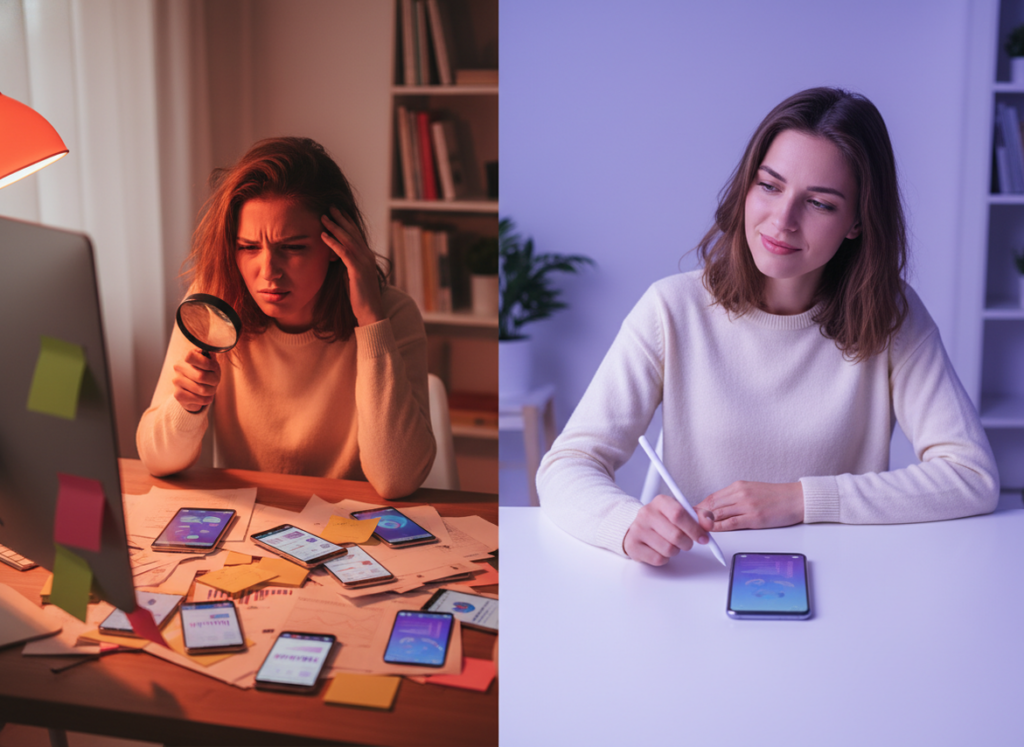
If you’re trying to track Instagram follower changes, screenshots are the “works in a pinch” option, and tools are the “I actually want to understand what’s happening” option. If you care about accuracy, trends, or even just your sanity, an app (or Instagram Insights) wins.
The only time I still use screenshots is when I need a quick receipt for one moment in time (like a brand deal reporting screenshot) or I’m tracking a competitor’s public count. For your own account, screenshots turn into a messy guessing game fast.
This is a real-world comparison of track instagram follower changes screenshots vs app: how each method works, where each one breaks, what Instagram tells you natively, and what I’ve seen creators mess up over and over.
The quick verdict (and who should pick what)
If you want “Did I gain or lose followers and why?”, use Instagram Insights plus a tracker tool. If you want “Proof I had X followers on Tuesday,” screenshots are fine. That’s basically the split.
- Use screenshots if you only need a one-off record (brand reporting, a bet with a friend, quick competitor snapshot).
- Use Instagram Insights if you want free, official follower gains/losses and audience info for the last 90 days.
- Use a compliant follower tracker if you care about who unfollowed, non-followers, ghost followers, and daily alerts.
- Use a spreadsheet if you’re patient, consistent, and want unlimited history (but you’ll still miss “who” unless you pair it with a tracker).
And yes, I’ve tried doing it “the simple way” with screenshots for weeks. I lasted nine days before I got annoyed and stopped. Twice.
Comparison table: screenshots vs Insights vs apps vs spreadsheets
Here’s the cleanest way to look at it.
| Method | What you can track | What you’ll miss | Effort level | Where it breaks |
|---|---|---|---|---|
| Screenshots | Follower count at a moment in time | Who unfollowed, trends, context, accuracy over time | High (manual) | When you forget, change devices, or compare across time zones |
| Instagram Insights | Gains, losses, net change, audience basics (7-90 days) | Exact accounts that unfollowed | Low | When you need history beyond 90 days |
| Follower tracking tools | Unfollowers, non-followers, growth history, ghost followers, alerts | Perfect “why” attribution (Instagram doesn’t give that fully) | Low | If the tool isn’t API-compliant or asks for your password |
| Spreadsheets (manual logs) | Unlimited history of counts you record | Who unfollowed, anything you forgot to log | Medium-high | When life happens and you miss entries |
How each method actually works (the mechanics, not the marketing)
1) Screenshots: a static receipt, nothing more
Screenshots don’t “track” anything. They just freeze a number. Then you become the tracking system, manually comparing images and trying to remember what changed.
Where this gets weird is the timing. If you screenshot at 11:58pm one night and 8:10am the next morning, you’ll blame “a post” when the drop was actually a late-night bot purge or a bunch of people cleaning their following list at midnight. I’ve seen that exact pattern a lot on accounts that post Reels daily.
Lived detail: on larger accounts (50k+), your screenshot-to-screenshot delta can look chaotic because unfollows happen constantly in the background. You might “lose 40” and “gain 43” within the same hour and your screenshots catch random slices of that.
2) Instagram Insights: the best free option, with a hard limit
Instagram’s Professional Dashboard Insights is the most underrated tool in this whole conversation. It gives you follower gains and losses across 7, 30, and 90-day windows, plus basics like top locations and active times.
The reason it works better than screenshots is simple: Insights is reading Instagram’s internal event data. You’re not approximating from a number you happened to capture. You’re pulling from the source.
But it’s not magic. It won’t show the list of accounts who unfollowed you. Instagram keeps that private on purpose. (If they exposed it natively, the platform would turn into even more petty follow/unfollow warfare than it already is.)
3) Tools/apps: automation, identity-level changes, and alerts (if done right)
A good tracker tool essentially does scheduled checks and compares follower/following states over time. When an account disappears from your follower list between snapshots, it flags it as an unfollow.
Here’s the thing most people miss, it only works reliably if the tool’s playing by Instagram’s rules. If an app’s screen-scraping, asking for your password, or hammering refresh like crazy, look, it’s not just sketchy, it usually breaks sooner or later. Instagram changes stuff constantly and those tools break first.
I’ve personally watched “popular” tracker apps go from working fine to randomly missing unfollows after an Instagram update, then suddenly pushing you to re-login. That’s the danger sign. If it needs your IG password, I’m out. Always.
If you want a safer option that doesn’t ask for your password, that’s the whole point of Instagram Follower Tracker. It’s built to stay compliant, which is boring… until you’ve been locked out of an account for 24 hours and you realize boring is good.
4) Spreadsheets: the “I’m disciplined” method (and I respect it)
If you’re the type who can log numbers consistently, a spreadsheet is surprisingly useful. You can build unlimited history, annotate dates when you posted certain content, and even track competitor counts weekly.
But spreadsheets don’t solve “who unfollowed.” They solve “how many.” Different problem.
Also, vulnerable moment: I’ve tried doing daily spreadsheet logs at the same time every day, and I still missed days. Travel, events, life, whatever. Your chart gets holes fast.
Counterintuitive insight: screenshots feel safer, but they create worse decisions
You’d think screenshots are “neutral” and apps are “extra.” Actually, it’s usually the opposite.
When people rely on screenshots, they tend to check obsessively and react to noise. You post a Reel, screenshot an hour later, and panic because you’re down 12 followers. Then you change your content strategy based on a random fluctuation.
Tools (or Insights) smooth that out. They push you toward week-over-week patterns instead of hour-by-hour mood swings. And honestly… that’s where the real growth decisions come from.
What I’ve seen in the wild (real patterns from testing)
I’ve tested tracking on small accounts (under 1k), mid accounts (5k to 20k), and bigger creator accounts. The behavior isn’t identical.
- Small accounts: one unfollow feels like a crisis. Screenshots make it feel personal. It’s usually not.
- Mid accounts: you start seeing “silent churn,” where you gain and lose daily even when you aren’t posting. Tools make this visible.
- Larger accounts: you’ll see periodic cleanups where spammy or inactive followers drop. In 2026, bot/inactive rates are still real (around 14.1% by many estimates), even if enforcement is tighter. A snapshot won’t tell you if the drop was quality-related.
And yes, Reel-focused creators really do grow faster a lot of the time. I don’t even argue with it anymore. The moment an account shifts from “pretty photos sometimes” to consistent Reels, the growth curve usually changes within 2 to 4 weeks. It’s not instant, but it’s noticeable.
If you want a broader stats view on how Instagram audiences behave now, this roundup is solid: Instagram followers statistics.
Failure modes: where screenshots and tools fall apart
Screenshots fail when consistency fails
This falls apart when you don’t capture at the same time, on the same view, with the same account context. Change one thing and you’re comparing apples to… slightly different apples.
Also: if you’re using screenshots to “prove” someone unfollowed you, you can’t. All you can prove is your count changed. You don’t know who did it unless you also had a saved follower list, which Instagram doesn’t hand you nicely.
Apps fail when they’re shady or overly aggressive
The big failure mode for tools is login risk. If an app requires your Instagram password, you’re trusting a third party with the keys to your house. And I’ve seen accounts get hit with suspicious login prompts and temporary restrictions after using those.
Even “legit-looking” apps can fail if they rely on brittle methods. If you suddenly notice gaps like “it didn’t record yesterday,” that’s usually a sign the app got rate-limited or couldn’t fetch the data consistently.
If you want the bigger picture comparison between manual approaches and tracking tools, this pillar page lays it out nicely: Instagram Tracker vs Manual Tracking.
So what should you do? My practical setup (that doesn’t make you crazy)
If you want a setup that works for most creators and small businesses, do this.
- Use Instagram Insights weekly (not daily) to check gains/losses and audience changes. Weekly reduces noise.
- Pick one consistent check time if you’re also logging counts (I like mornings, before posting). Don’t overthink it.
- Use a tracker tool for identity-level changes (unfollowers, non-followers, ghost followers), because Insights won’t tell you “who.”
- Screenshot only when you need a receipt, like campaign deliverables or a competitor check-in.
Want a deeper comparison of “manual check” vibes vs actual alerts? This breakdown is worth a read: manual unfollower checks vs tracker alerts.
And if you’re deciding between “I’ll just build a spreadsheet” and “I’ll use an app,” you’ll like this one too: spreadsheet tracking vs follower tracker apps.
Common mistakes I see constantly (and yes, I’ve done some of these)
- Comparing day-over-day and spiraling. Week-over-week is where signal lives.
- Using screenshots as “tracking” and then realizing you can’t answer basic questions like “when did it start dropping?”
- Chasing follower count while ignoring engagement. With bot/inactive followers still floating around, raw numbers can lie.
- Installing a random app that asks for your password because it has flashy charts. Don’t.
- Trying to identify every unfollower’s motive. You won’t. It’s not worth the energy.
If you’re curious how reliable manual methods really are (and where they mislead you), this one gets specific: how accurate manual tracking on Instagram really is.
Limitations (real talk)
No method will perfectly explain why someone unfollowed you. You can correlate timing with content, sure, but Instagram doesn’t provide a clean “unfollow attribution report,” and it probably never will.
Also, tools can only detect changes they have time-stamped data for. If you set up a tracker today, it won’t magically tell you who unfollowed you last month. It starts from when you start tracking. That’s just how it works.
A few notes on privacy, notifications, and screenshot myths
This topic comes up a lot because people worry about being “caught” tracking. The short version: Instagram doesn’t generally notify users when you screenshot most things, but Stories have had exceptions and experiments over the years, which is why everyone’s confused.
If you want a broad overview of follower tracking approaches, this guide is a decent outside read: how to track Instagram followers. For a roundup of tracker categories and what to watch for, this one is also helpful: Instagram follower trackers overview.
FAQ (screenshots, Stories, and follower tracking questions)
Can someone tell if I screenshot their followers on Instagram?
No. Instagram doesn’t notify someone if you screenshot their followers list or profile page.
Does Instagram notify you if someone saves or screenshots a pic?
For regular feed posts, Instagram doesn’t send screenshot notifications. Saving a post to Collections is private, too.
How do you know if someone screenshots your Instagram story with the most recent update?
In most cases, you don’t. Instagram has tested features in the past, but there isn’t a consistent, built-in “Story screenshot notifier” you can rely on.
Can you see if someone screenshots or screen records your story on Instagram?
No, Instagram typically doesn’t show you a list of who screenshotted or screen-recorded your Story.
Conclusion: screenshots are a receipt, tools are tracking
If your goal is genuinely to track instagram follower changes screenshots vs app, think of screenshots as a one-time snapshot and tools as an actual system. Screenshots are fine for proof. They’re rough for patterns. And patterns are what help you grow.
If you want the “who unfollowed, who doesn’t follow back, ghost followers, daily alerts” side of things without handing over your password, take a look at Instagram Follower Tracker at followertracker.app. It’s the kind of boring, consistent tracking that keeps you out of trouble and actually answers the questions you’re asking.